Views: 0 Author: Site Editor Publish Time: 2026-11-09 Origin: Site


A New Approach to Equipment Insulation Efficiency: A Full Guide to Aerogel Melamine Composite Foam
With the rapid growth of the new energy industry and the continuous upgrading of high-end equipment manufacturing, equipment insulation and thermal management have become decisive factors for equipment safety, service life and energy efficiency. A growing number of applications — power battery packs, charging piles, motors and motor controllers, rail transit, industrial piping and energy storage equipment — now require insulation materials that combine low thermal conductivity, high temperature resistance, inherent flame retardancy, thin and flexible construction and environmental compliance in a single solution.
Conventional insulation materials rarely manage to cover all of these requirements. Organic foams have a low temperature ceiling, need added flame retardants, and release smoke and toxic gases when they burn; inorganic fibers tolerate high temperatures but generate dust, offer limited flexibility and are difficult to fit onto complex shapes.
Is there a material that insulates efficiently, resists flame safely and still adapts to tight, irregular spaces? Junhua New Materials answers with aerogel melamine composite foam.

1. What Is Aerogel Melamine Composite Foam
In terms of composition, this is a typical nanocomposite. A three-dimensional open-cell melamine sponge serves as the structural skeleton, while nanoporous silica aerogel is uniformly filled into the pores, forming a dual-scale, multi-level insulation network of “macro-cell framework plus micro-nano pores” that combines the exceptional insulation of aerogel with the mechanical advantages of the sponge substrate. Thanks to an in-situ compounding process, the aerogel is distributed evenly throughout the foam pores, avoiding local starvation and property stratification. Thermal conductivity and flame retardancy stay consistent across the entire sheet, batch-to-batch consistency is high, and the material meets the quality control requirements of large-scale industrial supply.
The value of this composite lies in the complementary strengths of the two materials. Pure aerogel insulates extremely well but has weak mechanical properties and a brittle nature: under external force it crumbles and sheds powder, which makes it difficult to process on its own. Melamine sponge has a continuous, interconnected 3D cell structure with excellent toughness and compression recovery, so it can act as a carrier skeleton that holds the aerogel firmly in place and solves the industry's long-standing problem of brittleness and dusting. In the composite, the material retains the extreme insulation provided by nano-scale pores while fully inheriting the flexible, easy-to-cut and die-cuttable processing characteristics of the sponge — bringing insulation, flame retardancy, flexibility and a wide service temperature range together in a single material, and achieving insulation and flame protection in one.

2. Why It Delivers Far Better Thermal Insulation
Heat is transferred by conduction, convection and radiation. Nanoporous silica aerogel contains an enormous number of nano-scale pores whose size is smaller than the mean free path of air molecules. At the microscopic level this suppresses convective heat exchange, cuts off gas conduction paths and weakens radiative transfer, driving thermal conductivity down to an extremely low level: measured thermal conductivity does not exceed 0.016 W/m·K, and insulation performance is roughly twice that of conventional sponge and fiber insulation materials — a substantial improvement in thermal performance.
More importantly, for the same insulation result this material needs only about half the thickness of conventional insulation. Ultra-thin grades of just 0.2–3 mm achieve strong thermal isolation, so where internal space is at a premium the insulation layer occupies far less volume and frees up room inside the equipment, supporting more integrated and more compact designs. Whether the task is blocking heat on the hot side or preventing condensation on the cold side, it performs reliably and makes an ideal material for equipment insulation design.
3. Five Core Product Advantages
Compared with mainstream rubber sponge, polyurethane sponge, glass wool and rock wool products, aerogel melamine composite foam builds five differentiated advantages through formulation innovation and process optimization, each of them targeting a specific pain point in high-end applications.
(1) Ultimate Insulation: Ultra-Thin, High Efficiency, Space Saving
Nano-scale pores suppress air convection and gas conduction at the microscopic level, giving a thermal conductivity as low as 0.016 W/m·K. For the same insulation performance the material needs only about half the thickness of conventional products; grades of 0.2–3 mm already insulate effectively, sharply reducing the volume taken up by the insulation layer inside equipment and freeing internal space to support more integrated and more compact designs.
(2) Wide Temperature Range with Stable Hot/Cold Cycling
Many conventional organic foams soften, shrink, deform and melt above 120 °C, while ordinary inorganic fibers powder and collapse after repeated thermal cycling. Through a special composite modification process, this composite foam reaches a continuous service temperature of 240 °C and will not shrink, deform, crack or powder even under short-term high-temperature surges. At the low end it works down to -160 °C and stays flexible in deep-cold conditions, covering a wide range from cryogenic to medium-high temperatures, with only slight performance degradation under the repeated thermal cycling caused by equipment start-up and shutdown.
(3) Inherently Flame Retardant, Halogen-Free and Eco-Friendly
Built on the intrinsically self-extinguishing chemistry of the melamine molecule, the material is inherently flame retardant. No flame retardant additives are needed in production, and it is halogen-free. It chars and self-extinguishes when exposed to open flame, does not melt or drip, and does not release large amounts of dense smoke or toxic gases when it burns. It has passed major international and domestic fire certifications including UL94 V-0 and GB 8624 B1, and complies with RoHS and REACH requirements, making it suitable for rail transit, energy storage, new energy and other fields with strict fire safety standards.
(4) Flexible and Lightweight, Conforming to Complex Narrow Spaces
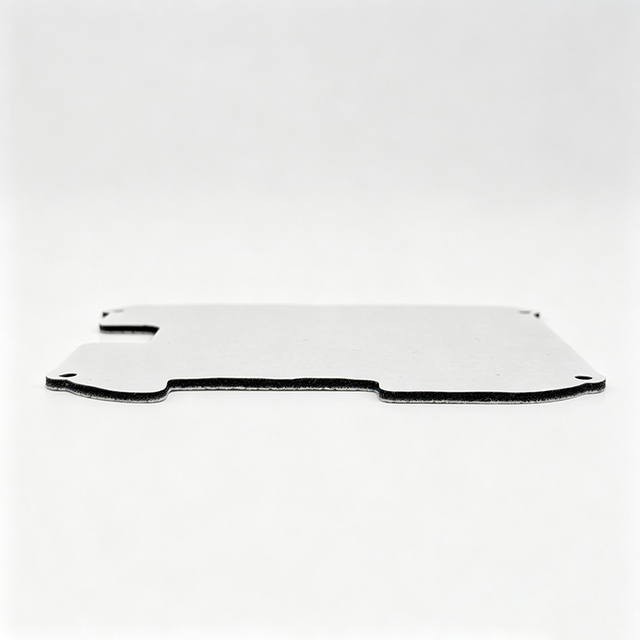
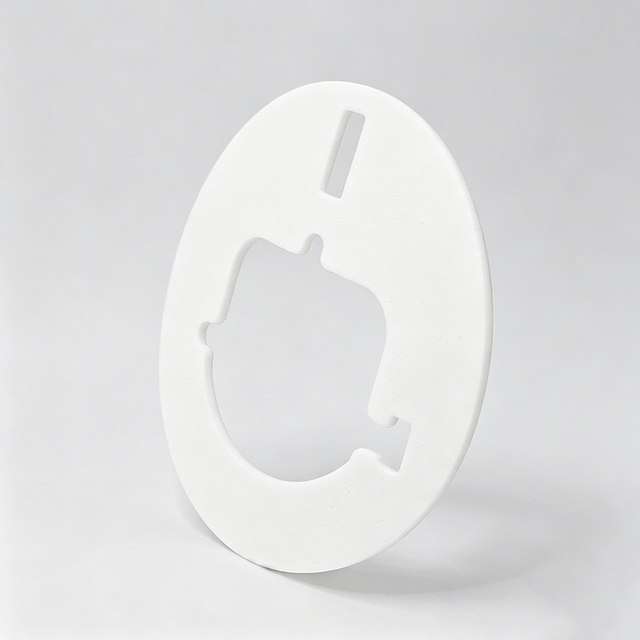
Unlike brittle pure aerogel felt or ceramic fiber board that sheds powder, this material is soft throughout, with good compression recovery, moderate density and low weight, and can be easily cut, folded and wrapped around curved surfaces. In narrow gaps and irregular cavities inside equipment, it compresses to fit tightly against component surfaces, eliminating air gaps between the insulation layer and the parts and preventing thermal bridges, so overall insulation performance is preserved. It suits both manual low-volume assembly and die-cut, customized parts for high-speed automated production lines.
(5) Integrated Lamination Capability for Multi-Functional Performance
The surface can be laminated with aluminum foil, flame-retardant nonwoven fabric, adhesive film and other materials, delivering insulation, sound absorption, fire protection and moisture resistance in a single product. This solves thermal control, noise reduction and moisture protection in one step and provides a complete insulation solution for equipment.

4. Typical Equipment Insulation Applications
Thanks to this combination of properties, the composite foam is widely used in equipment insulation applications.
In new energy and energy storage, thermal isolation of power battery packs and insulation of charging piles and storage cabinets are key requirements for thermal management materials. In fast-charging power banks and other portable power supplies, 0.2–1 mm ultra-thin foam is bonded to the inner wall of the housing to form a dense insulation barrier; combined with a graphene heat-spreading sheet, it blocks and spreads heat at the same time, keeping component heat inside and holding the housing surface temperature safely within limits. This helps products pass 3C (CCC) certification, eliminates the “too hot to touch” problem, reduces heat damage to the cells and extends service life.
In aerospace and rail transit, lightweight thermal isolation, sound insulation and fire protection for airborne equipment and cabin components place strict demands on materials. No matter how widely operating temperatures fluctuate or how complex the structure is, this thin, flexible material provides dependable support for equipment insulation and thermal management.
5. Company Strength and Technical Support
For many years Junhua New Materials has focused on melamine sponge and composite insulation materials, driven by material technology innovation. The company has progressed from basic melamine sponge products to aerogel composite materials and on to multi-functional integrated insulation components. It holds 23 proprietary patents and 7 registered trademarks, along with a full set of international certifications including UL, IATF 16949, ISO 9001/14001/45001, RoHS, REACH and BSCI. Its standardized plant has an annual capacity of 200,000 m³, supported by 20,000 m² of warehousing and fully automated splitting, vertical cutting, die-cutting and lamination equipment, ensuring on-time delivery of large orders. From material selection and testing to solution design, from sample validation to volume delivery, Junhua provides end-to-end technical support so that every project is implemented successfully and meets its targets.
Conclusion
From glass wool and rock wool to organic foams and now to aerogel composite nanomaterials, the history of insulation materials is a history of continuous technological innovation that keeps pushing the boundaries of performance.
Junhua aerogel melamine composite foam is a representative product of this wave. It deeply integrates the extreme insulation of aerogel with the flexible flame retardancy of melamine sponge, using one composite material to meet multiple requirements — insulation, fire protection, temperature resistance, flexibility and environmental performance — and opening new possibilities for equipment insulation in high-end equipment. Choose Junhua to improve equipment insulation efficiency and make thermal management safer, more efficient and more space-saving.